
 By
By 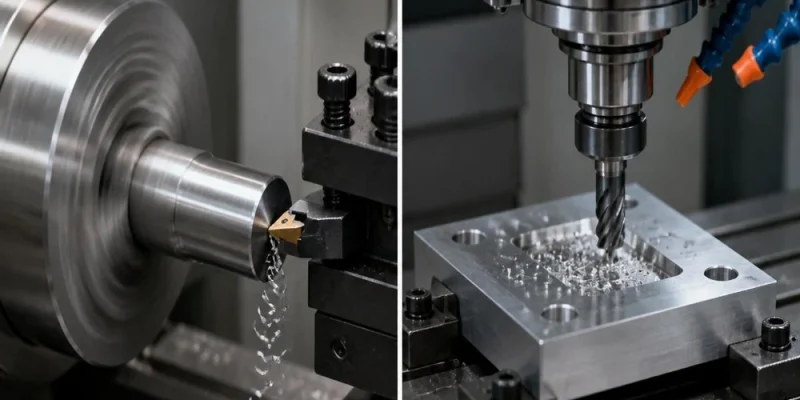
Key Highlights
- CNC turning is ideal for creating symmetrical, cylindrical parts using a rotating workpiece.
- CNC milling uses rotating cutting tools to remove material from a stationary workpiece.
- Turning is generally faster for round components, while milling handles complex, non-cylindrical shapes.
- The choice between the two depends on the geometry of the part and the required surface finish.
Introduction
In the world of precision manufacturing, understanding the nuances between different machining techniques is vital for producing high-quality components. Computer Numerical Control (CNC) machining has revolutionised the industry, but it is not a one-size-fits-all solution. Two of the most common processes used by engineers are CNC turning services and CNC milling services. While both rely on computerised instructions to shape material, the mechanics of how they operate are fundamentally different. Choosing the wrong method can lead to increased costs, longer production times, or parts that do not meet the necessary specifications. By examining the core differences in movement, tooling, and application, buyers can make informed decisions about which service best aligns with their specific project requirements.
1. Movement of the Workpiece and Tool
The most significant difference between these two processes lies in which element is moving. In CNC turning services, the workpiece itself is secured in a chuck and rotated at high speeds. A stationary cutting tool then moves along the rotating material to shave off layers and create the desired shape. This makes it perfect for creating items that are concentric or cylindrical. In contrast, CNC milling services involve securing the workpiece to a stationary or multi-axis bed. The cutting tool, which features multiple edges, rotates and moves across the surface of the material to carve out shapes. Because the tool moves rather than the part, milling allows for much greater freedom in the paths the cutter can take, enabling the creation of irregular geometries.
2. Tooling and Cutting Mechanisms
The types of tools used in each process also vary significantly. Turning typically employs single-point cutting tools that maintain constant contact with the rotating workpiece. This continuous contact is excellent for creating smooth, uniform surfaces on rounded parts. On the other hand, milling machines use multi-point cutting tools, such as end mills and face mills. These tools have multiple teeth that intermittently strike the material as they rotate. This intermittent cutting action is what allows milling machines to create slots, holes, and complex pockets that a lathe simply cannot achieve. While turning is specialised for external and internal diameters on a central axis, milling is the go-to choice for flat surfaces and intricate designs that require varying depths and angles.
3. Suitability for Part Geometry
When deciding between CNC turning services and CNC milling services, the shape of the part is usually the deciding factor. Turning is the most efficient method for producing bolts, shafts, pistons, and any other component that is essentially round or tubular. If your design features symmetry around a single axis, turning will almost always be the faster and more cost-effective option. However, if the part is square, rectangular, or has a complex organic shape with various features on different planes, milling is required. Milling machines can operate on three, four, or even five axes, allowing them to approach the workpiece from almost any direction. This versatility makes milling essential for engine blocks, moulds, and structural brackets.
4. Production Speed and Surface Finish
Efficiency and aesthetics also play a role in the selection process. For cylindrical parts, turning is generally much faster because the continuous cutting action removes material rapidly and consistently. It also typically produces a superior surface finish on rounded diameters, as the tool moves in a steady, linear fashion. Milling can sometimes leave visible tool marks or “scallops” depending on the path of the cutter, which may require secondary finishing processes. However, for parts that require high-precision holes or complex internal cavities, milling provides the accuracy that turning lacks. Modern hybrid machines, often called turn-mill centres, can perform both operations in one setup, but for most standard jobs, identifying the primary geometry remains the best way to choose the right service.
Conclusion
Both turning and milling are indispensable in the modern machine shop, each offering unique advantages for different types of components. CNC turning services provide the speed and precision needed for symmetrical, cylindrical items, while CNC milling services offer the versatility required for complex, multi-faceted parts. Understanding these four key differences-movement, tooling, geometry, and efficiency-allows manufacturers to select the most appropriate method for their designs. By choosing the right process, you ensure that your components are manufactured to the highest standards while staying within your budget and timeline.
Whether you need high-volume production or custom prototypes, contact Disk Precision Group to explore how our expert CNC turning services and CNC milling services can meet your exact specifications.






Comments